News & Events
Introducing the Official MGF Register Heritage Certificate
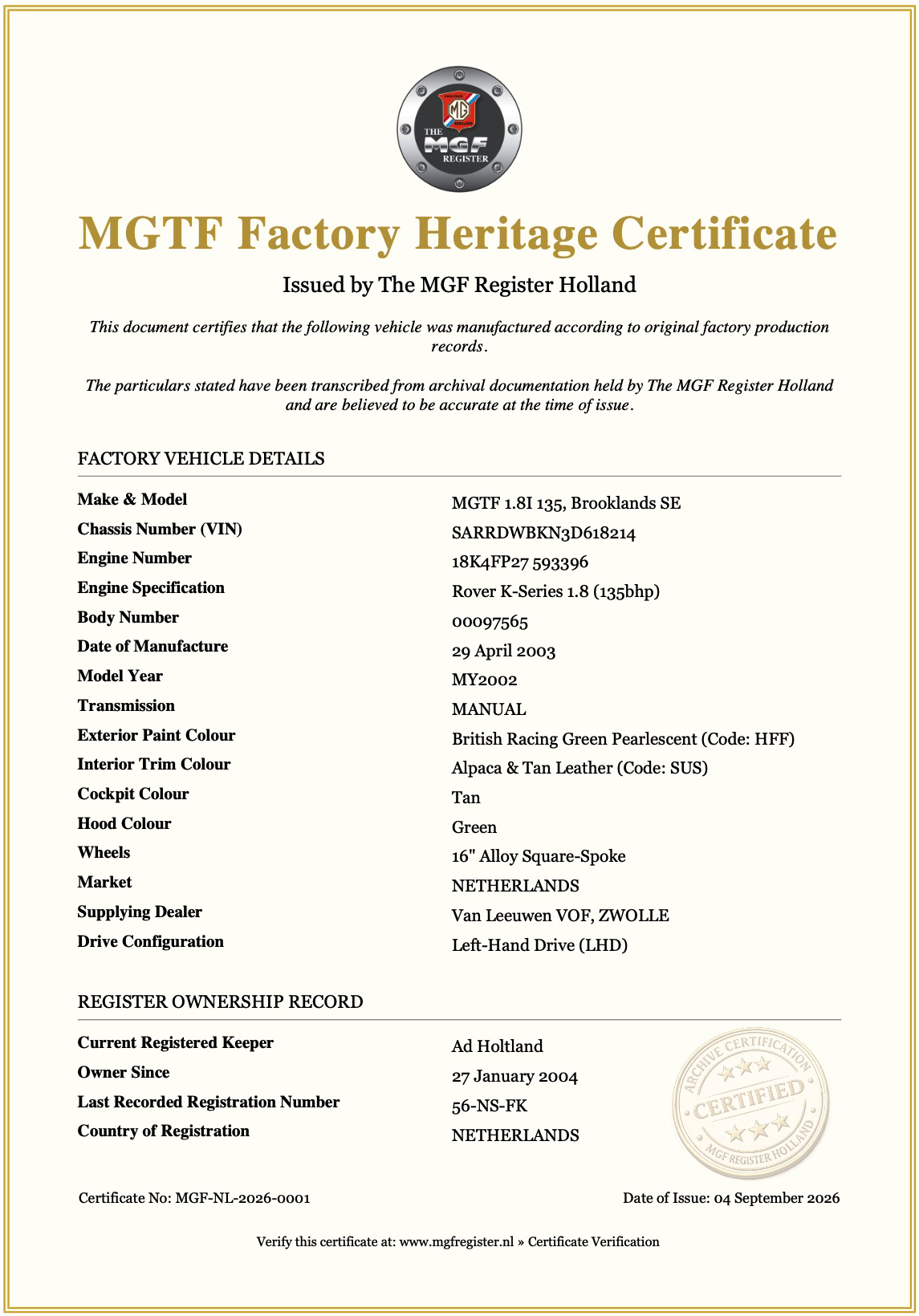 We are proud to present the new Heritage Certificate from The MGF Register Holland — a refined and beautifully designed document celebrating the unique identity of your MGF or TF.
Each certificate is carefully compiled using original factory production data, ensuring that the details recorded reflect how the vehicle left the assembly line. From chassis and engine specifications to original colours, trim, and build date, every element tells part of your car’s authentic story.
Every certificate is individually numbered and officially issued, making it a distinctive addition to your vehicle’s history file. Whether displayed with pride or preserved alongside your documentation, it enhances provenance and adds lasting value.
Available free of charge exclusively to registered owners with complete vehicle records, and any missing information can be added by the owner. The Heritage Certificate reflects authenticity and helps preserve the legacy of the MGF and TF for future generations.
To protect the integrity of the Heritage Certificate, each certificate can be verified online via our official verification page. Enter the unique certificate number to confirm its authenticity and view the vehicle details. No personal owner information is displayed.
Heritage Certificates issued
0 0 0 7 0

Enhanced Password Security
At the MGF Register Holland website, the safety of your account is our top priority. We’ve recently upgraded our password system to ensure that your information is as secure as possible.
All passwords are now hashed, which means they are stored in a secure format and cannot be read in plain text. This ensures that even in the unlikely event of unauthorized access, your password remains protected.
Any changes you make to your password are applied immediately, so you can continue using your account without delay or interruption.
Euro 95 is out, E10 is in. Will the
MGF & MGTF be able to run on E10 petrol?
From
Tuesday (October 1) petrol stations in the Netherlands are
selling the fuel E10 as a replacement for Euro 95. E10 is
cleaner but
not all cars are compatible, motoring organisation Bovag warns.
E10 contains up to 10% sustainable bioethanol and cars that run
on it
produce 2% less carbon dioxide on average. The European-wide
measure is
aimed at reducing dependency on fossil fuels. Petrol stations
with
fewer than two petrol pumps are exempt from the measure.
Car
dealers’ federation Bovag estimates some 700,000 cars in total
may be
unable to use the new fuel. As a rule, drivers of cars
registered prior
to 2002 are advised not to use E10 in their vehicle, as problems
have
been reported. Possible damage can be caused by bioethanol's
corrosive
properties which can lead to damaged seals, plastics and metals.
In
order to avoid these problems, owners can turn to so-called
premium
fuels, such as the more expensive Firezone Premium (98 RON),
Shell V-Power (98 RON) and
BP Ultimate (98 RON).
Toyo Proxes T1R tyre problems
The problem manifests
itself immediately after tyre change of its nature
when the cars become very unstable, especially at speeds above
approximately 70 km/h. This phenomenon was first seen in October
2014,
and over the following weeks several additional owners who all
simply
renewed their worn rear Toyo Proxes T1R for apparently identical
new
Proxes T1R suffered exactly the same problem. Tyre pressures
were not
to blame, and so this pointed to an issue related to the new
tyres. The
problem is as noticeable as it is simply because the MGF and TF
are so sensitive to tyre choice - a small difference in tyres
fitted to
most mainstream cars which doesn't cause any problem can easily
upset
the MGF and TF.
 Following
very
helpful
discussions with the Toyo's Technical
Department, the source of the problem has been quickly
identified and a
solution found. Basically, Toyo have had to apply some very
small
changes to the tyre make-up to ensure they fully comply with the
Tyre
Labelling Regulations (the label that gives various performance
factors
of the tyre). Unfortunately the small changes involved are
enough to
affect the MGF and TF and are generating the loss of stability.
The new
spec tyres are all Proxes T1R manufactured in Toyo's Malaysian
factory
and the Proxes T1R tyres made in their Japanese factory from
September
2014. All existing Proxes supplied and fitted to cars up
September 2014
will have been made in the Japanese plant and will be to the
older
specification.
Identifying
the tyres
is quite simple as the country of origin where
they were made is clearly moulded into the sidewall along with a
date
code with a four digit number.
The last two numbers of this code are
the year and the first two are the week number, starting from 1
January. There is often a prefix of letters and sometimes an
additional number before the date code numbers, but the date
code
always remains the last four numbers. The example in the second
image
shows
V6H1416, where V6H is a prefix and 1416 refers to week 14 of
2016.
 MGF
an TF
generate
more wear on rear tyres, so it is common that owners
will be facing renewal of the rear tyres before the front.
Owners of
cars that have been using these MG-approved Toyo Proxes T1R for
some
time are most at risk of encountering this problem, as it is
reasonable
for owners to expect that replacing the worn tyres with new
identical
(as they believe) MG-approved tyres will not create problems.
But the
new spec Proxes T1R (ie. all tyres made in Malaysia and those
made in
Japan from September 2014) will, when fitted to the rear of an
MGF or
TF while the earlier spec Japanse made Proxes T1Rs remain on the
front,
almost certainly cause the problems described.
However, if the front
tyres are replaced with the newer spec Proxes T1R to match the
rear,
than the handling should return to normal, as has been seen on
several
cars originally affected. There is obviously a cost implication
to
owners in this. (Incidentally there is no specific data to say
that
having old spec Toyo Proxes T1R on the rear and then fitting the
new
spec ones on the front will cause any problem as it is the rear
tyres
that are controlling influence, but we do not have any data from
cars
set up in this way.
One final important
point is to ensure that the correct MG-recommended
tyre pressure are set, as a too common issue is that owners and
indeed
tyre fitters feel they know better than the MG chassis
development
engineers and unilaterally decide to apply their own thoughts on
pressure. This usually relates to the common 36 psi/2,4 bar rear
pressures for the MGTF and MGF Trophy 160 models, and dropping
these to
normal MGF pressures significantly degrades both handling and
stability.
Source: MG Enthusiast
Currently there are no events scheduled.